Real Results

Case Studies That Speak Louder.

Every number below is ad-attributed and pulled directly from the Amazon Advertising Console. No estimates, no guesswork.

Amazon PPC · Baby Products Brand · SP + SB + SD

$331K

in ad-attributed sales on $92.7K spend · 3.57x ROAS · 28.32% ACoS · two-month window
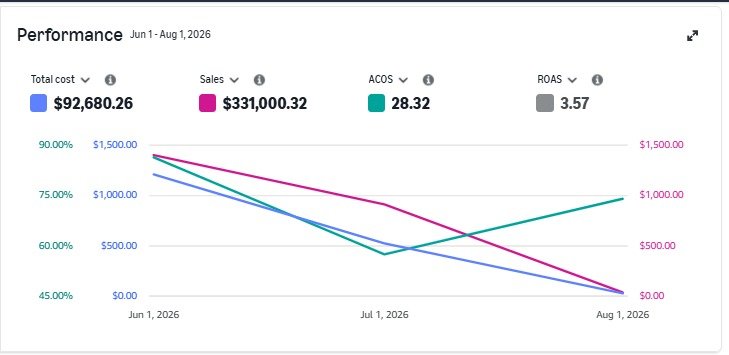
Amazon Ads console performance for the baby products brand, Jun 1 to Aug 1, 2026: $92,680.26 total cost, $331,000.32 sales, 28.32 ACoS, 3.57 ROAS Amazon Ads console · Baby products brand · Jun 1 to Aug 1, 2026

Our role: Amazon PPC management running full-funnel Sponsored Ads (Products, Brands, Display) for a US baby products brand

The Challenge

Baby is a trust category. A parent will not buy something for a newborn from a brand they have never heard of unless the listing, the reviews and the ad all say safe, and the big brands and Amazon's own label defend every generic term, so the clicks are expensive. The searches are stage and gift driven: "newborn", "6 month old" and "baby shower gift" all mean different things to bid on, and customers age out fast, because a buyer of a first-stage product is gone within months unless you bring them back for the next one. The brief was to run spend at more than $45K a month for two months without the blended ACoS crossing 30%.

Our Strategy

Spend followed trust. Ads were only scaled behind listings that already had the review base and the content to convert a cold click, and the weaker listings were held at maintenance budgets until they earned it, because in baby a great keyword pointed at a thin listing just burns money. Keywords were segmented by stage (newborn, 0 to 6 months, 6 to 12 months, toddler) so each product bid only on the stage it actually fits, and gift searches like "baby shower gift" got their own campaigns with their own bids, because a gift buyer converts differently from a parent. Sponsored Brands video ran on the category terms showing the product in use on a real baby, which is the proof parents look for before they trust a new brand. Sponsored Display handled the two things a baby brand cannot afford to skip: views remarketing for parents who research for days before deciding, and next-stage targeting so a customer who bought for a newborn is shown the product for the age that comes next. Monthly budgets were paced to the $45K target, with each product line held to its own ACoS ceiling.

Results (two-month window)

Sales $331,000 on $92,680 of spend: 28.32% ACoS, a 3.57x return, across all three ad types combined (Jun 1 to Aug 1, 2026). That is more than $45K a month of spend held at a blended ACoS under 30%, with every dollar of ad spend coming back as $3.57 in attributed sales, and the remarketing and next-stage layers running for the full period rather than trimmed to protect the ratio.

Why It Matters

In baby, the cheap way to a good-looking ROAS is to defend your own name and let the big brands own every generic term. Holding 3.57x across two months while bidding on the stage and gift terms where new customers actually come from, with video, remarketing and next-stage targeting all switched on, is what growing a baby brand without buying revenue at any price actually looks like.
Amazon PPCSponsored Brands & DisplayStage-Based TargetingBaby ProductsNext-Stage Cross-Sell
Amazon PPC · Home Appliance Brand · SP + SB + SD

$241K

in ad-attributed sales on $79.2K spend · 3.03x ROAS · 33.12% ACoS · one-week window

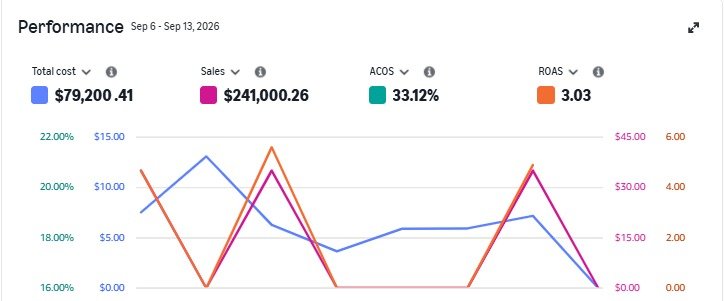
Amazon Ads console performance for the home appliance brand, Sep 6 to Sep 13, 2026: $79,200.41 total cost, $241,000.26 sales, 33.12 ACoS, 3.03 ROAS Amazon Ads console · Home appliance brand · Sep 6 to Sep 13, 2026

Our role: Amazon PPC management running full-funnel Sponsored Ads (Products, Brands, Display) for a US home appliance brand

The Challenge

Home appliances are one of the most expensive categories to advertise in on Amazon. Units sell at a high ticket, so every click is priced to match. The national brands hold Top of Search on the generic terms, and a shopper usually compares several listings before buying anything, which makes the path from click to purchase long and leaky: the buyer who clicked today often converts days later, on a different search, or on a competitor's page. The brief was to scale weekly spend hard into the pre-Q4 period without letting ACoS run away with it.

Our Strategy

Scaled in steps, not in one jump. Budgets went up only on campaigns that had already proved their ACoS, in increments, with three days of data before the next increase, so the account grew into the spend instead of buying its way there. Bids were set by placement: Top of Search multipliers only on exact terms with a proven conversion rate, everything else left to compete on rest of search at a lower cost. Sponsored Brands video ran on the generic category terms, because an appliance sells on seeing it work, not on a bullet point. Sponsored Display did the conquesting: product targeting on competitor listings with weaker ratings or higher prices, and views remarketing at 7, 14 and 30 days to bring back the comparison shoppers who left without buying. Weekend budgets were weighted up, because that is when appliance buyers actually decide, and search term negatives ran weekly to keep the scaled spend on terms that convert.

Results (one-week window)

Sales $241,000 on $79,200 of spend: 33.12% ACoS, a 3.03x return, across all three ad types combined in a single week (Sep 6 to 13, 2026). Every dollar of ad spend came back as $3.03 in attributed sales. That is close to $80K of weekly spend deployed at a scale where returns usually start to thin out, and the full mix still cleared 3x with the conquesting, discovery and remarketing layers all running at the same time.

Why It Matters

A high-ticket category is the easiest place to buy an impressive sales number: push bids up to hold Top of Search and the revenue shows up, but so does a 50% ACoS. Holding 33% while spending at this volume, with video, conquesting and remarketing switched on rather than trimmed to flatter the ratio, is what scaling an appliance account without giving up the margin actually looks like.

Amazon PPCSponsored Brands & DisplayCompetitor TargetingHome AppliancesHigh-Ticket Scaling
Amazon PPC · Pet Supplies Brand · SP + SB + SD

$98K

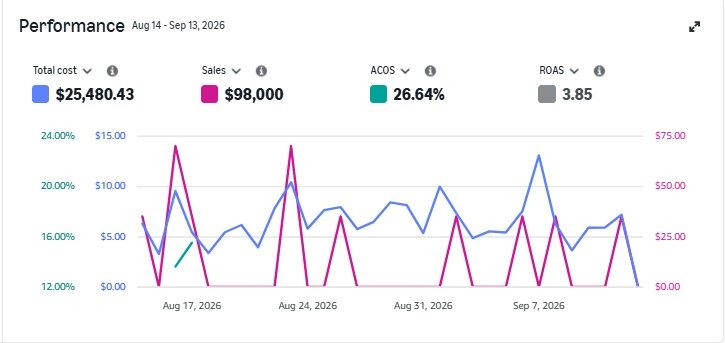
in ad-attributed sales on $25.5K spend · 3.85x ROAS · 26.64% ACoS · single 30-day window

Amazon Ads console performance for the pet supplies brand, Aug 14 to Sep 13, 2026: $25,480.43 total cost, $98,000 sales, 26.64 ACoS, 3.85 ROAS Amazon Ads console · Pet supplies brand · Aug 14 to Sep 13, 2026

Our role: Amazon PPC management running full-funnel Sponsored Ads (Products, Brands, Display) for a US pet supplies brand

The Challenge

Pet supplies is one of the most crowded categories on Amazon: every search term has the national brands, Amazon's own private label and a wall of near-identical generic listings bidding on it, and shoppers sort hard on price and reviews. Search terms sprawl, too. Species, breed, size and life stage all change what a click is worth, so a broad match campaign left alone will spend a dog budget on cat traffic. It is also a repeat-purchase category (treats, litter, pads, supplements), so the first order is usually buying a customer, not a sale: easy to overspend chasing volume, and just as easy to starve growth chasing a low ACoS.

Our Strategy

Started with the search term report, not the bids. The account was split by species first, then by product type, so dog and cat traffic never shared a campaign or a budget, and a negative list covering the wrong species, breeds and sizes was built before any spend was scaled. The head terms went into single-keyword campaigns with their own budgets, so a term like "dog dental chews" could be bid up or down on its own numbers without dragging a hundred long-tail terms with it. Auto campaigns stayed on for discovery only, feeding new terms into exact every week. Sponsored Brands ran on the branded terms and pushed to the Store, where a shopper sees the full range instead of one listing. Sponsored Display was the cross-sell engine: targeting our own complementary ASINs so a buyer of one product is shown the next thing their pet needs, which is where a repeat-purchase category actually makes its money. Each product line ran to its own ACoS ceiling, and budgets were stepped up through the month as each line held its number.

Results (single 30-day window)

Sales $98,000 on $25,480 of spend: 26.64% ACoS, a 3.85x return, across all three ad types combined (Aug 14 to Sep 13, 2026). Every dollar of ad spend came back as $3.85 in attributed sales, with budgets stepped up through the month rather than held flat, and the blended ACoS still landing under 27% with the cross-sell and discovery layers running the whole time.

Why It Matters

A pet brand can post a strong ROAS by spending only on its own name. Holding 3.85x while the discovery and cross-sell layers were switched on, and while spend was being pushed up rather than trimmed to flatter the ratio, is what profitable growth actually looks like in a category this crowded.

Amazon PPCSponsored Brands & DisplaySearch Term HygienePet SuppliesCross-Sell Targeting
Amazon PPC · Supplement Brand · SP + SB + SD

$156.4K

in ad-attributed sales on $44.2K spend · 3.70x ROAS · 27.01% ACoS · single 30-day window

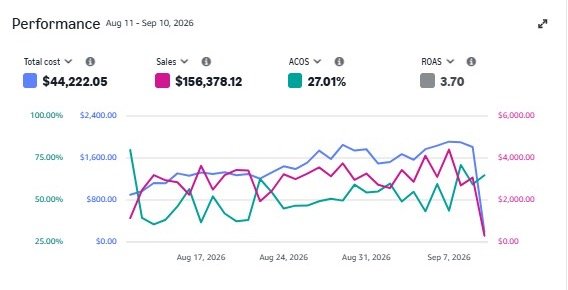
Amazon Ads console performance for Newt Nutrition, Aug 11 to Sep 10, 2026: $44,222.05 total cost, $156,378.12 sales, 27.01 ACoS, 3.70 ROAS Amazon Ads console · Newt Nutrition · Aug 11 to Sep 10, 2026

Our role: Amazon PPC management running full-funnel Sponsored Ads (Products, Brands, Display) for Newt Nutrition, a US-made supplement brand

The Challenge

Newt Nutrition sells five products that share almost no keywords, buyers or price points: men's performance and fertility support, SAM-e, bladder control, gray hair support and a travel pill organizer. Supplements are one of the most contested categories on Amazon, and men's health terms attract aggressive bidding, so ACoS drifts upward the moment attention lapses. The account also had to be clean enough to replicate across the brand's other Amazon marketplaces, not a one-off tangle of campaigns.

Our Strategy

Rebuilt the account on a strict naming convention with three objectives only: DEF to defend, GROW to expand and CATALOG to cross-sell. Each of the five products got its own portfolio with its own budget and ACoS ceiling, because a keyword that is cheap for the pill organizer is expensive for men's health and the two should never share a bid. Sponsored Products carried the volume, split by match type so exact terms could run higher bids than phrase and broad, with auto campaigns kept purely for search term discovery. Sponsored Brands sat on the branded terms and Sponsored Display targeted the brand's own ASINs, so a competitor could not buy the last click on Newt's pages. Search term harvesting and negatives ran weekly. The same structure was then carried into the brand's other marketplaces with local keyword sets, which is exactly what the naming convention was for.

Results (single 30-day window)

Sales $156,378 on $44,222 of spend: 27.01% ACoS, a 3.70x return, across all three ad types combined. In one week (Sep 3 to 9), 1,203,543 impressions and 10,777 clicks (0.90% CTR) produced $23,486 in attributed sales. On the top converting path (Sponsored Products to Sponsored Products to purchase), 84% of sales were new-to-brand: $7,914 from shoppers Newt hadn't sold to in the previous 12 months.

Why It Matters

A supplement account can post a big month by buying revenue at any price. Holding a blended 27% ACoS while the defensive and catalog layers are switched on, and while most top-path sales are brand-new customers, is what profitable growth actually looks like.

Amazon PPCSponsored Brands & DisplayBrand DefenseSupplementsMulti-Marketplace
Amazon Ads · KDP Publisher · 4 Marketplaces

$4.9M

in ad-attributed book sales on $1.98M spend · 2.5x ROAS · 39.73% ACoS · three-year lifetime view

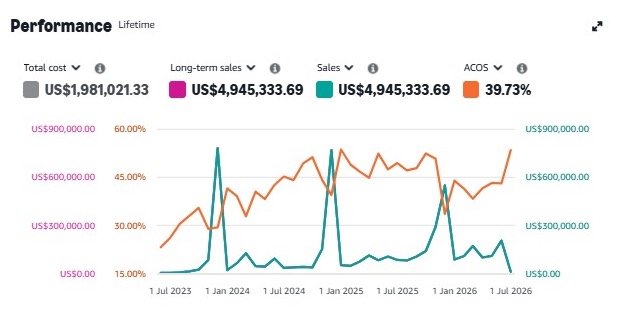
Amazon Ads console performance for the KDP account, lifetime Jul 2023 to Jul 2026: US$1,981,021.33 total cost, US$4,945,333.69 sales, 39.73% ACOS Amazon Ads console · KDP account · Lifetime, Jul 2023 to Jul 2026

Our role: Amazon Ads management for a KDP publishing account, running book advertising across four marketplaces

The Challenge

Books are the thinnest-margin product on Amazon. The whole margin is the royalty, so an ad that would be comfortably profitable on a supplement is a loss on a paperback, and there is no price lever to pull, because a book priced above its category simply stops selling. The catalog here was large and spread across four marketplaces, which means hundreds of thousands of possible keyword and ASIN targets, most of them worth nothing. Demand is also seasonal in a way most categories are not: sales spike every holiday season as gifting and new Kindle owners arrive, then settle for months. The job was to keep spending at scale for three years at a blended ACoS under 40%.

Our Strategy

Managed like a portfolio, not a bookshelf. With 473,175 targets in the account, the real work was pruning: every target that spent without a sale over a rolling window was paused or bid down, and the budget was moved to the small core that actually sells, which in the last 14 days of this view is 1,467 targets. Campaigns were built per book and per marketplace, so a title that works in the UK is never funded by its US numbers, and bids were set against each book's royalty rather than one account ACoS: a 70% royalty ebook can carry a 50% ACoS, a low-priced paperback cannot. Where a title was part of a series, the ads pointed at book one and the ACoS target was set on the read-through value of the whole series, not the first sale. Budgets were front-loaded into the holiday season, when gifting and new Kindle owners drive the biggest months of the year, and pulled back in the flat months. Auto campaigns stayed on for discovery only, feeding new keywords and ASINs into the exact campaigns every week.

Results (three-year lifetime view)

Sales $4,945,334 on $1,981,021 of spend: 39.73% ACoS, roughly a 2.5x return, across the full lifetime of the account (Jul 2023 to Jul 2026) and four marketplaces. Close to $2 million of ad spend deployed over three years came back as $4.9 million of attributed book sales, with the holiday peaks in the chart arriving three years running and the largest of them pushing a single month's sales past $700K.

Why It Matters

In books, a good-looking ACoS is easy for a month and hard for three years. Anyone can switch off the losing targets after the holiday rush and post a clean number. Keeping close to $2 million in spend working across four marketplaces, through three holiday cycles and the flat months in between, and still landing the whole lifetime under 40% ACoS, is what a publishing ads account run as a business looks like.

Amazon AdsKDP AdvertisingMulti-MarketplaceTarget Pruning at ScaleSeasonal Budgeting

Ready to Grow?

Let's Talk About Your Amazon Growth.

Have questions about your account or looking for your next growth opportunity? Book a free strategy call and let's see what's possible.

Book a Free Strategy Call →
  • No obligation
  • 30 minutes
  • Real strategies